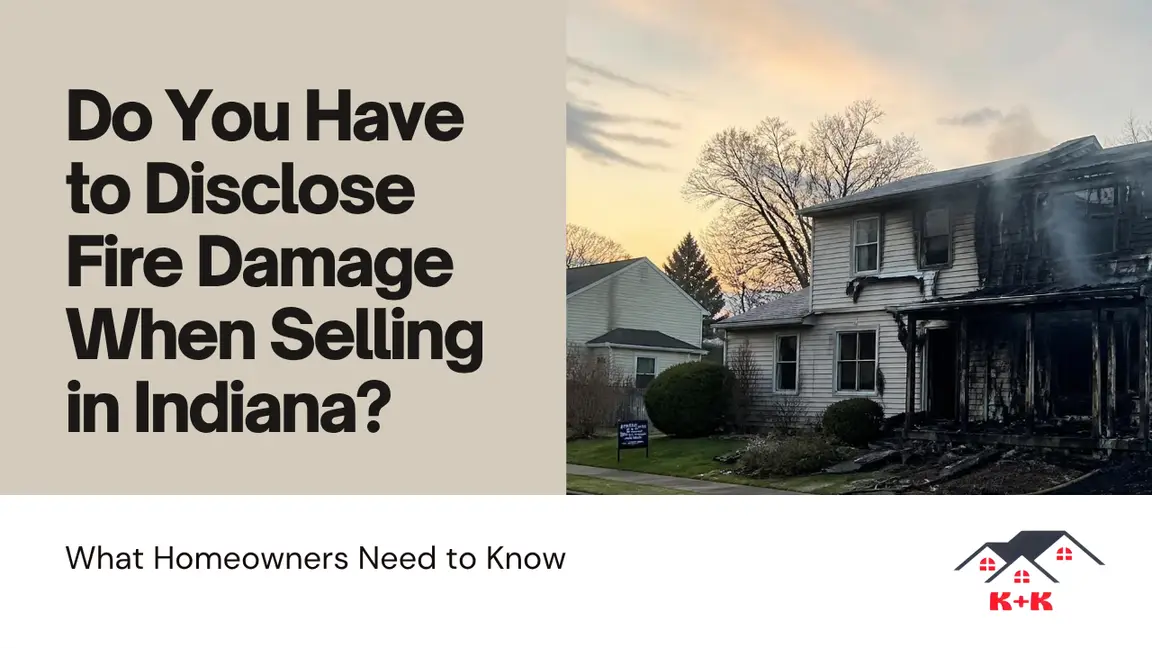

TL;DR: If you know about fire damage or other material defects, do not assume that selling a house as-is eliminates your disclosure obligations. Indiana’s residential real estate disclosure requirements and the current disclosure form should guide what you report. When the situation is unclear, use the current Indiana form and get professional advice rather than guessing. Use the current Indiana residential real estate disclosure form rather than relying on an old template.
If you are selling a house in Indiana that has been damaged by fire, one of the first questions you may have is: “Do I have to tell the buyer about it?”
Indiana has a residential real-estate disclosure law that requires sellers to disclose known conditions covered by the law. The required disclosure addresses areas including the foundation, mechanical systems, roof, structure, and water and sewer systems. Indiana’s definition of a defect focuses on conditions that can significantly affect property value, occupant health or safety, or the expected normal life of the property.
Fire damage can involve several of those areas. That makes documentation and accurate disclosure especially important.
| Legal note: This article provides general information, not legal advice. For questions about a specific sale, speak with an Indiana real-estate attorney or qualified real-estate professional and use the current state disclosure form. |
|---|
What Is Indiana’s Residential Real Estate Sales Disclosure?
Indiana requires a seller of covered residential property to provide a disclosure form concerning the known condition of specified parts of the property. The disclosure is not a substitute for a professional inspection, and the form represents the owner’s knowledge of the property’s condition.
Indiana updated the state Seller’s Residential Real Estate Sales Disclosure Form in 2026. The Indiana Professional Licensing Agency identifies the current State Form 46234 version as R9 / 2-26. Sellers should not rely on an old PDF found on a random real-estate website.
Does Fire Damage Count as Something You Need to Disclose?
The answer depends on the facts and what you know.
Indiana’s disclosure law focuses on known conditions covered by the disclosure form and the property’s material defects. A fire can affect the structure, roof, electrical or mechanical systems, interior materials, water systems, safety, and other physical conditions.
If you know the property has a condition that falls within the disclosure requirements, do not assume that calling the house “as-is” eliminates the issue.
What If the Fire Happened Years Ago?
A past fire does not simply become irrelevant because time has passed. The more useful questions are what happened, what was repaired, and what you actually know about the property’s current condition.
If the fire was fully repaired, keep the documentation. That might include insurance records, fire department reports, contractor invoices, permits, engineering reports, restoration records, receipts, and photographs.
What If the Fire Damage Was Fully Repaired?
That is different from pretending the fire never happened. A seller should answer disclosure questions based on the information the current form requests and the seller’s actual knowledge.
Do not guess. Do not embellish. Do not minimize. If you do not know something, Indiana law has provisions addressing information that is unknown or unavailable to the owner.
What About Smoke Damage?
Smoke damage is part of the overall property condition. If smoke affected the structure, surfaces, HVAC, contents, or other components, documentation about the remediation can be useful.
A future buyer may also want an inspection to understand the property’s current condition. The disclosure form is not a replacement for that inspection.
What About Water Damage From the Fire?
A fire loss can involve water used during firefighting. If water damage remains or created another material property condition, it should not disappear from the conversation simply because the original event was a fire.
That is another reason to keep restoration records.
What If You Are Selling the Property As-Is?
“As-is” describes the condition in which the buyer agrees to purchase the property. It is not a magic phrase that allows a seller to ignore known information.
Indiana law separately addresses seller disclosure obligations, defects, and changes in the property’s condition. If you plan to sell a fire-damaged home as-is, be especially careful about keeping the facts and documentation straight.
What Happens If the Property Changes After You Complete the Disclosure?
Indiana law addresses material changes discovered after the disclosure form is delivered. At or before settlement, the owner must disclose a material change in the physical condition of the property or certify that the condition is substantially the same as when the disclosure was provided.
That matters if, for example, a new leak appears after the disclosure or an existing problem becomes materially worse.
What Should You Keep Before Selling?
- Fire information: fire report and date of the incident
- Insurance information: claim number, correspondence and settlement documents
- Repair information: estimates, invoices, permits and contractor reports
- Condition information: photos, inspection reports and engineering reports if available
- Current property information: anything you have learned about remaining damage
This is not about creating a giant legal binder. It is about being able to answer basic questions accurately.
What If You Do Not Know the Full Extent of the Damage?
Do not guess. Indiana law specifically addresses information that is unknown or unavailable to the owner. The statute allows an owner to state that information is unknown or use an approximation that meets the law’s requirements.
Should You Have an Inspection?
An inspection can help a buyer and seller understand current property conditions. Indiana’s disclosure law distinguishes the disclosure form from inspections and warranties.
Whether you obtain an inspection before selling is a situation-specific decision. For a property with substantial fire history, professional evaluation may be particularly useful.
Selling a Fire-Damaged House in Indianapolis For the commercial option, see sell your fire-damaged house in Indianapolis.
If you are more interested in the selling decision than disclosure law, KK Buys Indy Homes has a dedicated guide for Indianapolis homeowners with fire-damaged properties.
Sell Your Fire-Damaged House in Indianapolis
Sources and references
- Indiana Professional Licensing Agency: Seller Disclosure Form Update, LSA Document #25-627
- Indiana Code, IC 32-21-5: Residential Real Estate Sales Disclosure
- Court of Appeals of Indiana: Residential disclosure discussion
- KK Buys Indy Homes: Sell Your Fire-Damaged House in Indianapolis